Emmenopterys henryi: The Belle of the Forest
Updated:2025-11-12 Source:Shennongjia National Park
Endemic to China,Emmenopterys henryi was first discovered in Yichang, western Hubei. This deciduous giant of the Rubiaceae family originated in the Cretaceous period approximately 100 million years ago. As a rare monotypic genus exclusive to China, it is classified as a National Grade II Protected Wild Plant.
Naturally distributed across broad areas, it grows on mountain slopes and valley streamsides at 430–1,630 m elevation. Preferring warm climates and moist fertile soil, it is a sun-adapted species. Valued for its elegant form and stunning autumn blossoms, it is an ideal ornamental tree. British botanist Ernest Henry Wilson praised it as "the most beautiful and enchanting tree in China's forests" in his book China: Mother of Gardens.
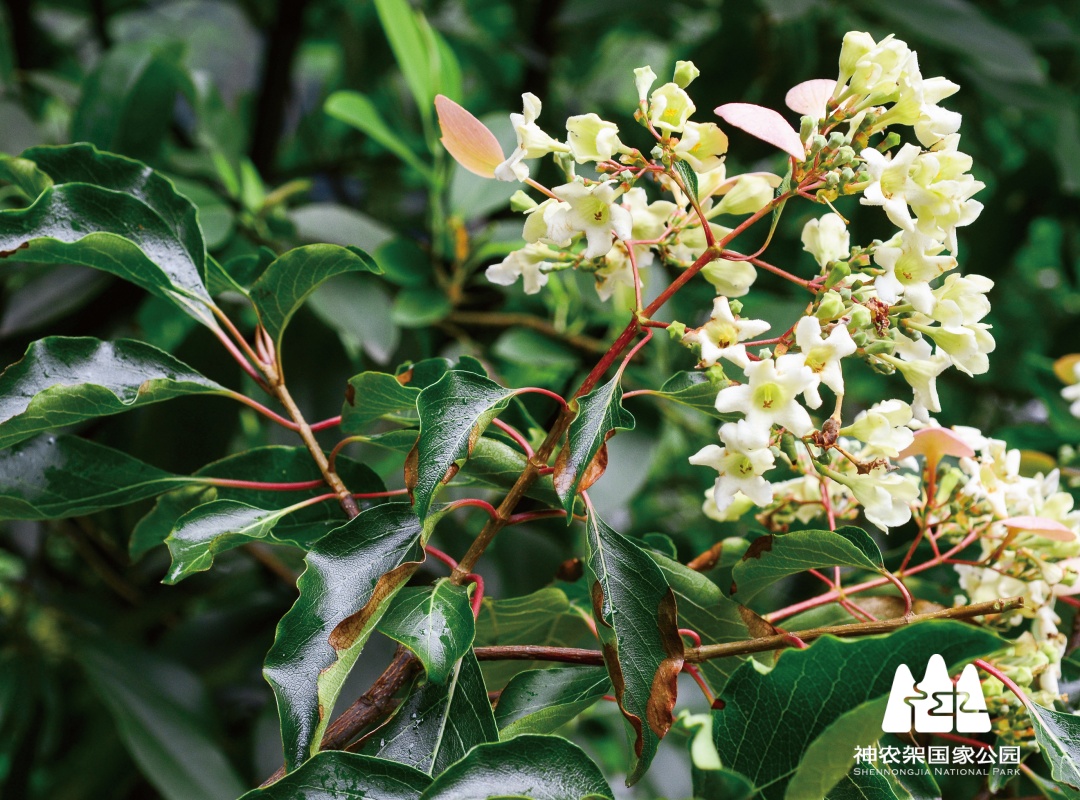
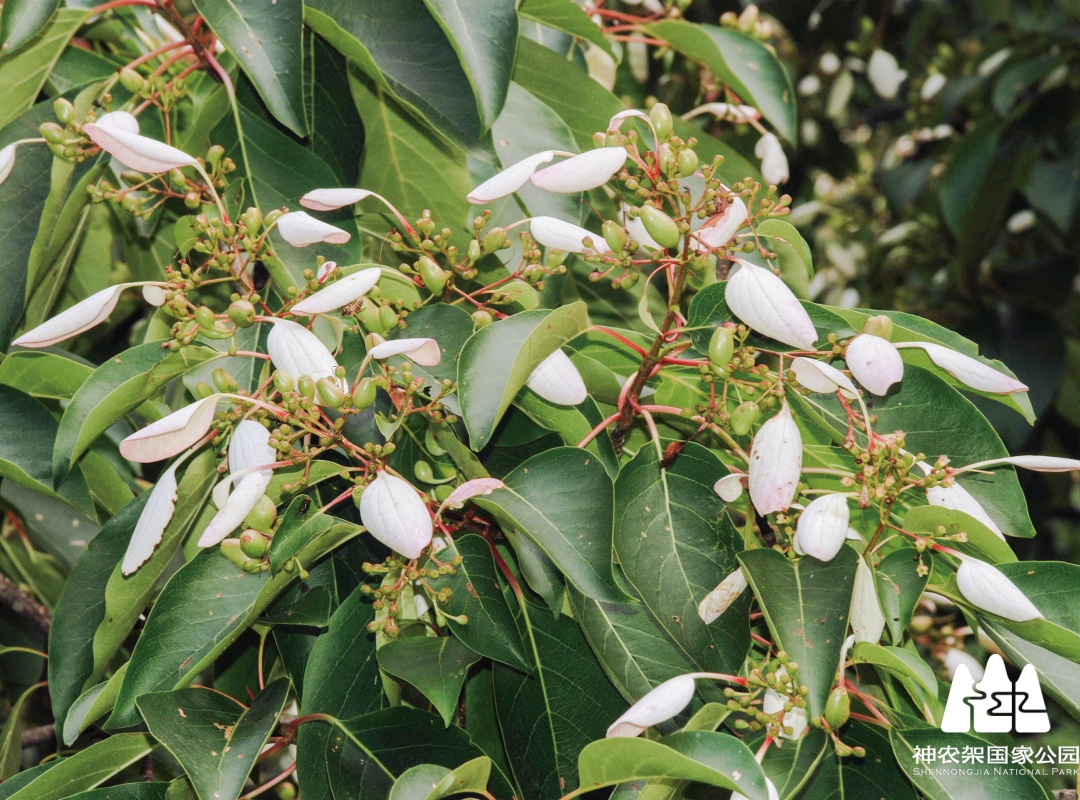
Chinese Materia Medica records its roots and bark can "warm the middle, harmonize the stomach, downbear counterflow, and check vomiting," treating hiccups and vomiting. Its bark fibers produce high-quality wax paper and rayon, while its tough, straight-grained wood serves excellently in construction, models, furniture, and carving.
In summer, if fortunate to witness its bloom, you'll see conical cymes swaying atop branches like maidens in lace-trimmed bonnets—a vibrant gathering. Flowers burst in white or yellow with intense fragrance. One sepal transforms into a leaf-like structure (white/pale red/yellow), persisting steadfastly until fruit ripens red. Breezes animate these specialized sepals, creating nature's "butterflies dancing among blossoms"—a dazzling spectacle. Truthfully, tall trees are rare in Rubiaceae family; Emmenopterys henryi's flamboyance brings great pride to its family.
While the phoenix's exclusivity ("perching only on Firmiana trees") reflects arrogance, Emmenopterys henryi—despite its modesty—struggles in hardship. It flowers and fruits only biennially or triennially, with extremely low fruit-set rates (dozens of blooms yielding one fruit). Seeds are minuscule, germination poor, and natural seedling establishment rare. Gradually, it was confined to the "wheelchair" labeled rare species. Its low fecundity stems from allocating excessive resources to blooms—its fondness for beauty, though not wrong, defines its biological choice.(Written by FU Wenlong Reviewed by JIANG Mingxi Photo by LIU Jun)
Species Profile:
Name:Emmenopterys henryi
Order: Rubiales
Family: Rubiaceae
Genus: Emmenopterys
Key Identification Features:
Deciduous tree, large; bark grayish-brown, scaly. Leaves papery to leathery, broadly elliptic, broadly ovate or ovate-elliptic. Inflorescence terminal, paniculate cyme; flowers fragrant, funnel-shaped, white to yellow. Fruit oblong-ovoid to subfusiform. Seeds small, with broad wings. Flowering period: June-August; fruiting period: August-November.
Native Distribution in China: Shaanxi, Gansu, Jiangsu, Anhui, Zhejiang, Jiangxi, Fujian, Henan, Hubei, Hunan, Guangxi, Sichuan, Guizhou, Yunnan.

Address:36 Chulin Road, Muyu Town, Shennongjia Forestry District, Hubei Province 鄂ICP备18005077号-3
Phone:0719-3453368