
Parasitic Jaeger, an Oceanic Visitor, Spotted for the First Time at Shennongjia's Dajiuhu Wetland
Updated:2026-06-23 Source:Shennongjia National Park
At around 6 p.m. on June 19, 2026, Miao Zongjie, a birdwatcher from Wuhan, spotted a bird with a black hood, white nape, rounded head, pale underparts and dark upper plumage on Lake No.5 at Dajiuhu Wetland in the Shennongjia National Park Candidate Area.After receiving the news, monitoring staff from the park’s scientific research institute rushed to the wetland at roughly 6 a.m. the following morning to take more photos. Images were later sent to avian specialists, who confirmed the bird as a Parasitic Jaeger (Stercorarius parasiticus). The sighting marks the first ever record of the species in Shennongjia and only the second verified occurrence across Hubei Province.
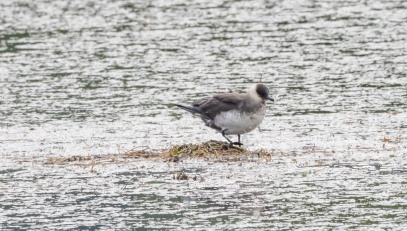 Parasitic Jaeger (Photo by Miao Zongjie)
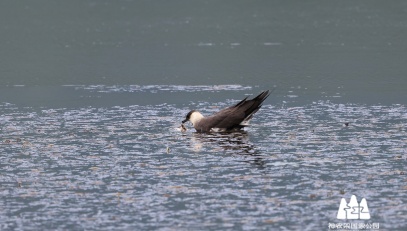 Field habitat (Photo by Ma Guofei)
The Parasitic Jaeger (Stercorarius parasiticus) is a medium-sized seabird from the family Stercorariidae under the order Charadriiformes, measuring 41 to 55 centimeters long. Its most recognizable trait is a pair of elongated central tail feathers that extend far beyond the rest of its tail plumes, known as rectrices. Males and females look identical, and the species has two distinct colour morphs.
The pale morph has a blackish-brown crown, yellow ear coverts and neck sides, plus dark brown back and wing feathers. The base of its primary flight feathers is white, its belly is pale, and its flanks and undertail coverts carry a greyish-brown tint. Its dark tail has pale bases, with the extended central tail feathers tapering to a fine point. In the dark morph, the whole bird is sooty brown with a black crown; only the base of its primary flight feathers shows a lighter shade. In non-breeding pale morph plumage, the crown is dark brown, the upperparts are brown with pale barring, and the underparts are also mottled. Juvenile jaegers resemble adults but are covered all over with clear feather barring. The bird has dark brown irises, a solid black beak and black legs (tarsi).
Parasitic jaegers breed on Arctic tundra and migrate to warmer seas outside breeding seasons. They normally live along coasts and open oceans and are extremely rare vagrants seen inland in China. Quick and agile in flight, they often steal food from other seabirds and follow ships to feed on discarded marine waste.
In Hubei Province, there has been only one previous record of the Parasitic Jaeger. Prior to this sighting, the province held just one confirmed record: a juvenile Parasitic Jaeger spotted by rangers at Xiangyang Hanjiang National Wetland Park on September 8, 2022. By contrast, the bird found at Dajiuhu is an adult pale-morph individual, making it Hubei’s second official record of the species.
 Parasitic Jaeger (Photo by Ma Guofei)
Dajiuhu Wetland’s rich fish stocks offer abundant food for this oceanic wanderer. The discovery further underscores the wetland’s critical role along the East Asian–Australasian Flyway, one of the globe’s nine major migratory bird routes, as an essential rest and feeding hub for migrating birds. It stands as powerful evidence of the site’s outstanding ecological and conservation value.(Written by Ma Guofei Translated by Xiao Xintong)

Copyright Shennongjia National Park
Address:36 Chulin Road, Muyu Town, Shennongjia Forestry District, Hubei Province 鄂ICP备18005077号-3
Address:36 Chulin Road, Muyu Town, Shennongjia Forestry District, Hubei Province 鄂ICP备18005077号-3
Email:2673990569@qq.com
Phone:0719-3453368
Phone:0719-3453368


TOP