Syrmaticus reevesii: Ultimately, a Chicken
Updated:2025-12-21 Source:Shennongjia National Park
Hee-yoo, hee-yoo... The forest echoed with one desperate cry after another — hee-yoo, hee-yoo. It was a young Syrmaticus reevesii calling out in distress. Clearly, the poor pheasant had lost its way. It was crying for its mother, trembling as if asking, “Where am I? Where am I?”
The little pheasant would never call for its father, for the male Syrmaticus reevesii sires but does not rear. Nor is his affection reserved solely for the mother of this little pheasant. Thus, the young one might easily come across half-siblings sharing the same father. Having fought hard to defeat rival males, the triumphant pheasant naturally claims two or three females as his own.
Like many pheasants, it is the male Syrmaticus reevesii that dazzles the eye, while the female dresses plainly. With tail feathers stretching up to a remarkable 1.5 meters, these plumes are often used in Peking Opera, adorning the helmets of military commanders. As actors sing, recite, gesture, and spar on stage, those long feathers do more than embellish — they embody the character’s shifting emotions.
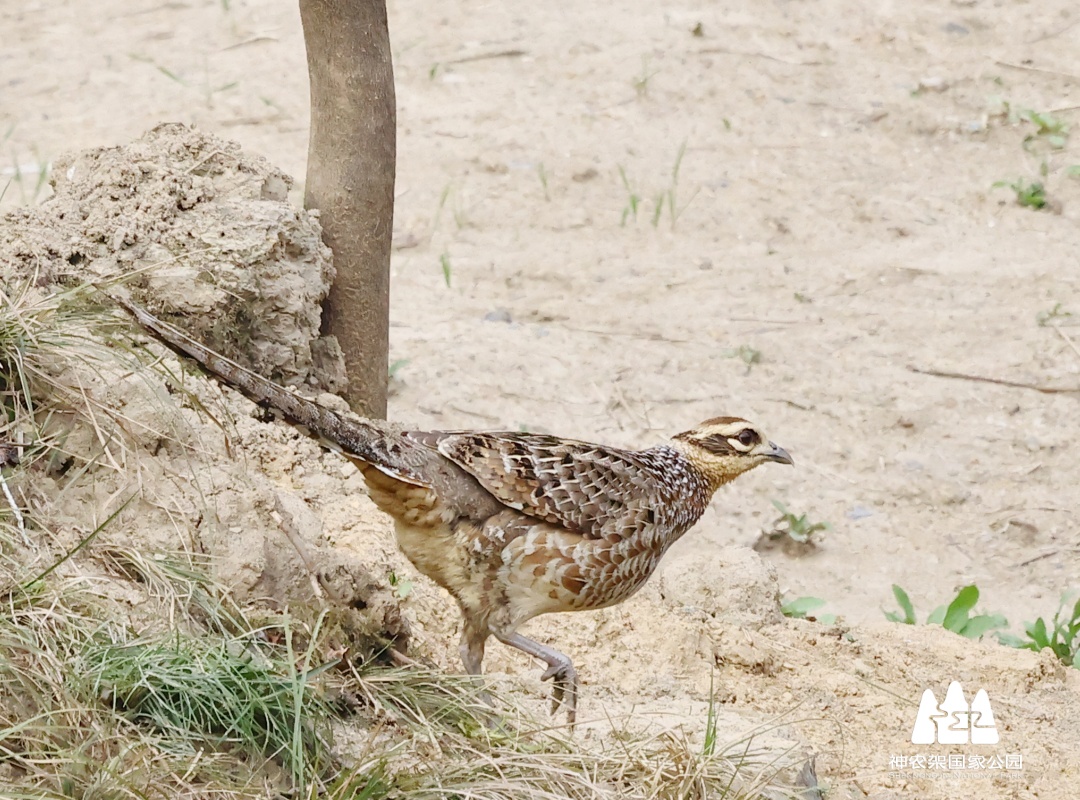
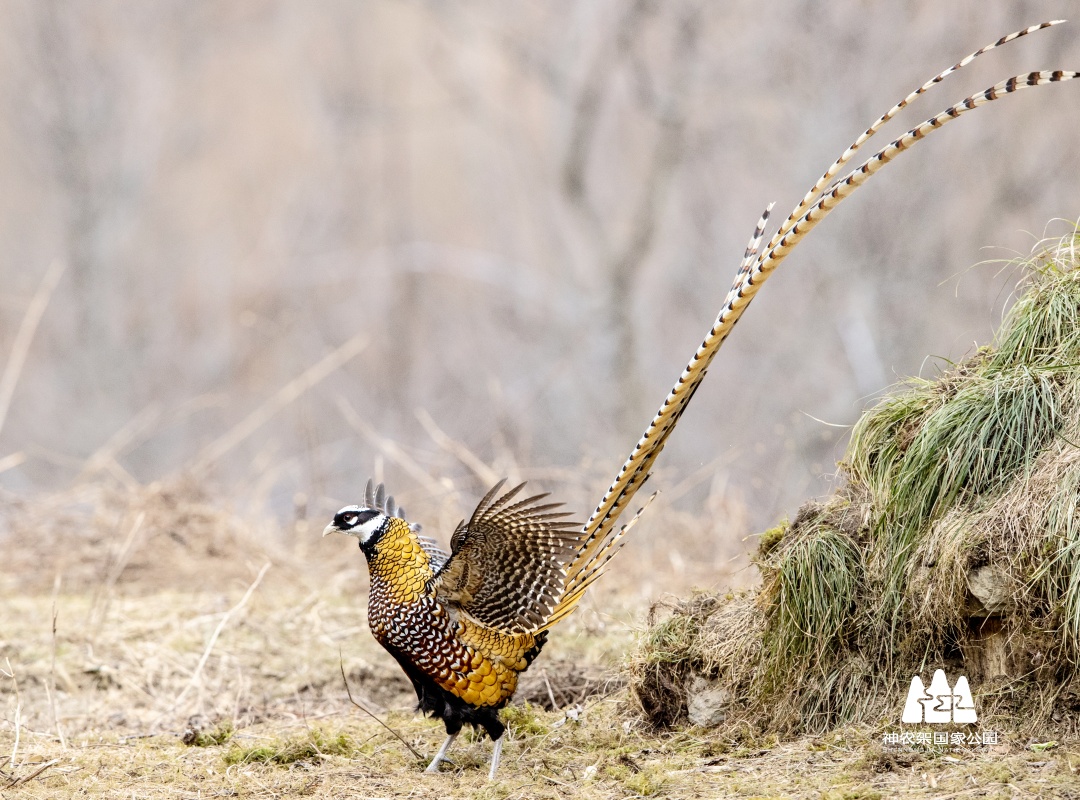
Located at the lower back, the tail feathers function like a rudder. Besides maintaining balance, they help change flight direction. Forest-dwelling birds constantly navigate around trees, which explains their relatively longer tails. While functional long tail feathers are common in both sexes of many species, the stark difference between male and female Syrmaticus reevesii suggests the male’s extravagant plumage serves a stronger decorative purpose. Indeed, the male’s magnificent tail plays a crucial role in attracting females and maximizing mating opportunities.
As inhabitants of mountainous forests, their exceptionally long tails require a unique takeoff technique: they must first ascend vertically above the treetops before leveling into forward flight. When moving from tree to tree, they can perform abrupt stops, using their long tails for balance. They pivot their bodies backward, employing both tail and wings to brake against airflow, landing securely on a branch.
Syrmaticus reevesii lives at elevations of 600–2,000 meters in central and eastern China. Of China’s four long-tailed pheasant species (Syrmaticus reevesii, Syrmaticus Mikado, Syrmaticus humiae, Syrmaticus ellioti), the Syrmaticusa reevesii is the most widespread. In the Shennongjia area, they frequent spots like Dongxi, Huangbaiqian, and Yanziya.
Despite their beauty, these birds are modest nesters. A simple nest in the grass suffices for laying seven or eight eggs, with scant layers. The hen fiercely guards her brood and may even leap up to chase and peck at humans if disturbed.
Interestingly, Syrmaticus reevesii tame quite readily. Once domesticated, a hen can lay 40-50 eggs per year. Beneath those splendid feathers, they’re still chickens, after all!(Written by Shui Yi Editted by Zhao Xinru Photo by Ma Guofei Liu Sanxia)
Profile
Scientific Name:Syrmaticus reevesii
Order:Galliformes
Family:Phasianidae
Genus:Syrmaticus
Key Identifiers:
The male Syrmaticus reevesii is a large bird, measuring about 180 centimeters in total length, and is instantly recognizable by its spectacularly long, barred tail feathers that can extend up to 1.5 meters. Its head displays a crisp black-and-white pattern, while the upperparts appear golden-yellow with dark feather edging that creates a distinct scaled effect. The center of the belly and the thigh feathers are black.
In contrast, the female has a noticeably shorter tail and shows rich reddish-brown scaling across the breast.
Range in China:
Southern Henan, Southern Shaanxi, Southeastern Gansu, Northeastern Yunnan, Sichuan, Chongqing, Guizhou, Hubei, Western Hunan, Western Anhui.

Address:36 Chulin Road, Muyu Town, Shennongjia Forestry District, Hubei Province 鄂ICP备18005077号-3
Phone:0719-3453368