The Mountains Forge a Poem, A Silent Guardian of the Green Heart
— In Commemoration of Li Pinhong, a Ranger in the Candidate Area of Shennongjia National Park
Updated:2026-02-01 Source:Shennongjia National Park
Shennongjia in deep winter is a tapestry of layered peaks.Covered by heavy snow it was dressed into a vast white landscape. Setting out from Wuhan via high-speed rail, then switching to a long bus journey along winding roads, followed by a car ride—a nearly ten-hour trek finally brought this reporter to the heart of the candidate area for Shennongjia National Park: the Shuihe Management & Conservation Center of the Laojunshan Agency of the Administration of Shennongjia National Park. The city's clamour had long been washed away by the forest wind, leaving only the murmur of the Shuihe River. At the path's end, a tall, lean figure waved warmly. He was the subject of this visit: Li Pinhong, a ranger from the post-80s generation. This lengthy journey mirrored the decade he has spent silently taking root here, guarding the ecological barrier of the Roof of Central China.
A Decade's Hardships: The Wilds Enhanced His Initial Resolve
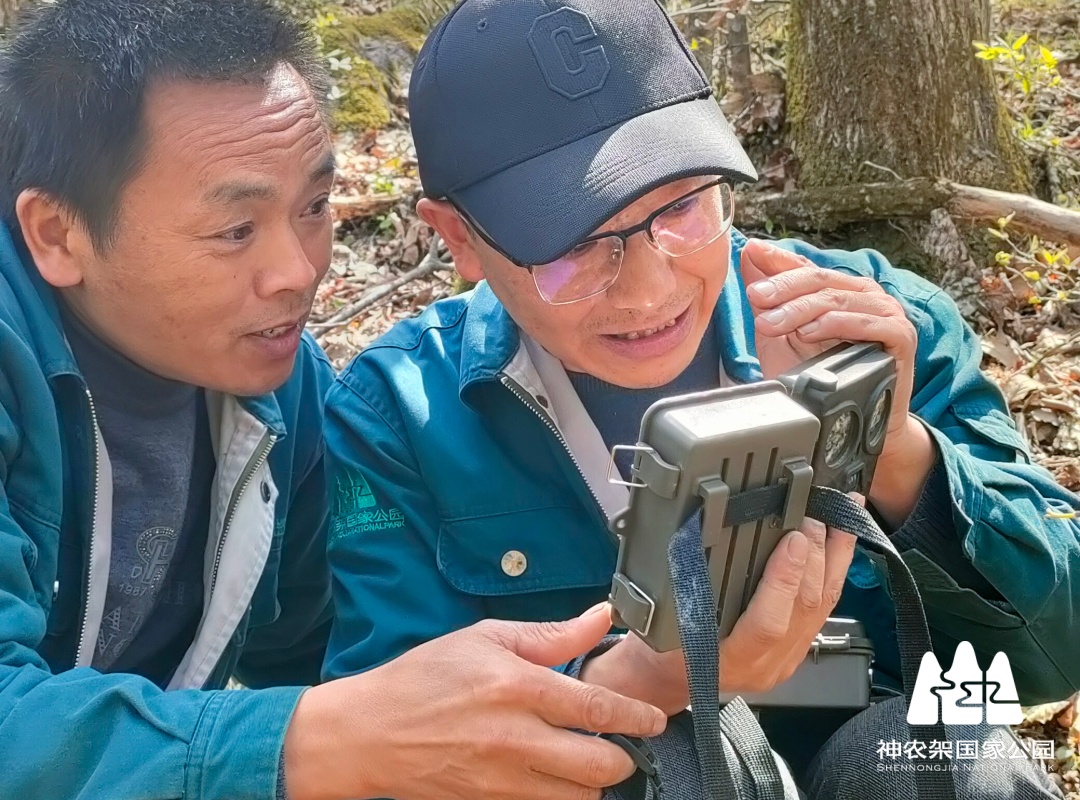 李品红(右)和队友查看红外相机录像
At first meeting, Li Pinhong, with his neat work clothes, close-cropped hair, and a pair of slightly worn glasses, exuded a scholarly air. However, when he handed over a cup of hot tea, his outstretched hands told a completely different story: palms thick with calluses, the backs crisscrossed with scars, and arms revealed by his short sleeves showing a stark tan line silently proclaiming the hardships endured in the wilds. This seemingly gentle “post-80s” youth has deeply imprinted his most valuable ten years of youth upon this pristine forest.
Li Pinhong’s connection with ecology began in 2008 with cultural and tourism work at the Administration of Shennongjia Dajiuhu National Wetland Park. “The core of tourism development is a healthy ecosystem. Taking inventory of our resources is the first step.” Participating in ecological resource surveys forged an indissoluble bond between him and nature. In 2016, he volunteered to go to the more remote and challenging Shuihe Management & Conservation Center of the Laojunshan Agency, becoming a full-time conservation officer guarding the vast green mountains of Songluo Town, a “Hubei Provincial Forest Town.”
What does conservation entail? “Mountains, rivers, forests, farmlands, lakes, grasslands, sands—the entire mountainside is our field of responsibility.” Li Pinhong's core tasks include documenting and protecting ancient and famous trees and conducting systematic ecological resource surveys, which require detailed data support over five-year cycles. Routinely, he takes shifts patrolling with his mere four colleagues at the center, spending about ten days each month working in the field within the primitive forest areas.
“Patrolling the mountains? It's not as easy as the song “The King Told Me to Patrol the Mountain” suggests,” Li Pinhong said with a laugh, displaying his pack: tent, sleeping bag, dry rations, monitoring instruments, first aid kit, self-defense equipment... A backpack weighing over fifty pounds is standard. The patrol routes crisscross, with the farthest outposts like Yingwodong and Chezigou requiring a full five days of hiking one-way. On cliffs like the Amitofoya near 3,000 meters, where the rock faces are sheer, they often need to climb using both hands and feet.
Braving the wind and dew is his norm. Crouching under leeward rocks, they chew cold, hard bread or biscuits, grab a few wild berries to stave off hunger, and then hurry on their way. When night falls, they curl up in thin tents, falling asleep to the howls of wild beasts. Danger is a constant shadow. In the summer of 2018, a sudden downpour forced Li Pinhong and a colleague to take shelter in a bamboo grove on a cliff. As rain poured down like a waterfall, the sound of breaking branches came from above, followed by heavy footsteps and panting grunts—a burly Asian black bear appeared less than twenty meters away! “It felt like my blood froze. We could only lean against the cold, wet rock, praying it hadn't spotted us," Li Pinhong recalled, a flicker of fear still in his eyes. Fortunately, the bear ambled away.
This spring, on another patrol route, they encountered a troop of wild macaques. These seemingly cute creatures can be very aggressive. Occupying the high ground, they picked up stones and branches and hurled them down. Faced with such intrusions from these “uninvited guests,” the rangers showed a remarkable tolerance: “This indicates the ecological chain is intact. They feel secure enough to act so boldly. The improving ecology allows the animals to live freely and unrestrained.”
Promoting Coexistence: Technology Connects Community
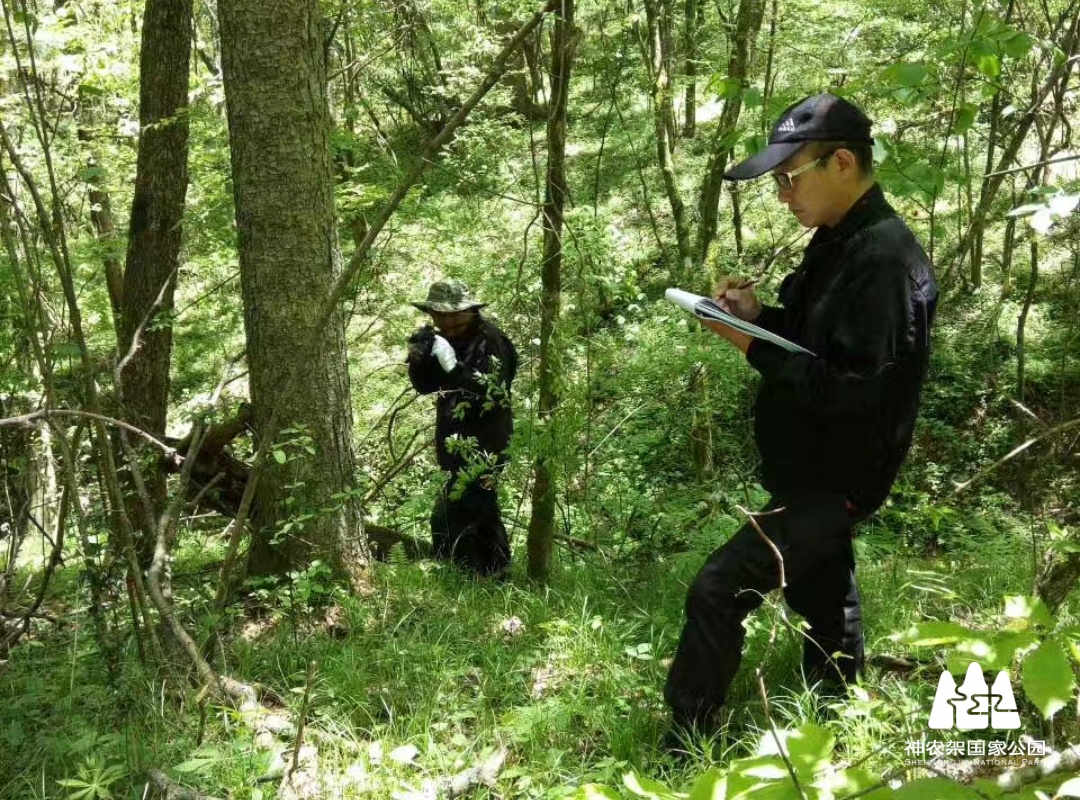 森林调查,李品红记录着每一株植物的生长情况和坐标
The duties of the Shuihe Management & Conservation Center extend far beyond patrolling the mountains. Li Pinhong and his colleagues are also often seen in nearby Zhongling Village and Changfang Village. When meeting locals in the fields, they never fail to remind them: "Don't set traps for the muntjacs, wild boars, or birds in the forest—harming them is illegal!" These simple words, like the spring rain nurturing growth, allow the seeds of ecological protection to take root in the villagers' hearts.
This spring, a Chinese serow, a national second-class protected animal, injured its leg and stumbled into the courtyard of a farmhouse in Changfang Village. The villagers showed no panic or attempt to drive it away, let alone any thought of harm. They immediately notified the Shuihe Center. Li Pinhong swiftly initiated an emergency response, contacting the National Park's Xiaolongtan Wildlife Rescue Station. Thanks to the villagers’ ecological awareness and the center’s rapid response, this precious serow received timely treatment. It's a vivid example of ecological protection awareness taking hold among the people.
Technology is becoming the “eyes” guarding the green mountains and clear waters. In the remote gullies, cliffs, and water sources of Songluo Town, a number of infrared cameras stand guard silently through wind and rain, like tireless “eyes in the secret realm.” “They are ideal tools for non-invasive wildlife surveys,” Li Pinhong explained. They can incisively detect heat sources 24 hours a day, recording countless hidden and precious moments: the elegance of golden snub-nosed monkeys drinking, the wariness of Chinese serows foraging, the cute look of black bears rubbing against trees.
Regularly traversing treacherous terrain to maintain and replace camera batteries and memory cards, and collecting and organizing the massive amounts of footage, is a crucial part of Li Pinhong and his team’s work. This first-hand data from the depths of the forest provides irreplaceable evidence for scientific research, monitoring, and species protection strategies in the candidate area of Shennongjia National Park. In December 2019, at the first infrared camera image competition for the Shennongjia National Park candidate area, the “Chinese Serow” image captured by Li Pinhong and his colleagues Gong Yongbao and Wu Qishun won an award. These “eyes” not only allow researchers insight into the wild but also enable the public to “encounter wildlife undisturbed,” conveying the value and effectiveness of ecological protection.
A Deep Vow for the Everlasting Mountains: The Extraordinary Forged from the Ordinary
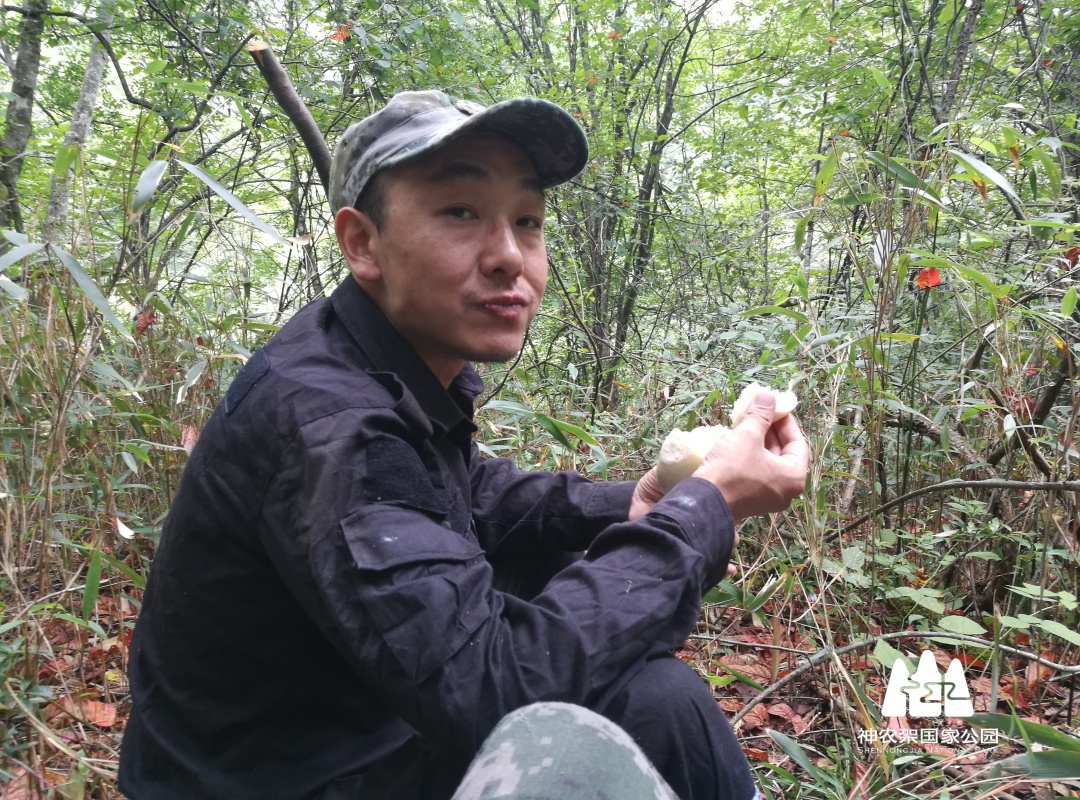 巡山小憩,李品红用冷馒头充饥
“There are only five of us at the center; we all treat this place as home,” Li Pinhonig said, gazing calmly and proudly at the continuous green mountains outside the window of the Shuihe Center's duty room. However, his somewhat weary complexion “betrayed” the hardships behind this statement: long-term exposure to cold and wet, irregular meals, and chronic conditions like rheumatism and stomach ailments have become the “occupational marks” for many of his colleagues.
As a grassroots Party member with over a decade on the front lines of ecological protection, Li Pinhong’s words are simple yet carry great weight: “I always bear in mind the Party’s purpose, firmly guarding this pure land of Shennongjia.”
Day after day, year after year. Recording tree growth, monitoring the change of water quality, investigating illegal logging, poaching, and fire hazards, maintaining infrared cameras... These monotonous, repetitive “trivial tasks” build the foremost and most solid front line of defense for the ecological security of the Shennongjia National Park candidate area.
They are the loyal sentinels of the green mountains. In midsummer, the forest is stifling like a steamer, with leeches and mosquitoes fiercely attacking. In harsh winter, heavy snow seals the mountains, knee-deep snow making progress difficult. During the rainy season, mountain paths are muddy and slippery; in autumn, walking near cliffs requires extra vigilance... Yet they always appear punctually on various mountain peaks, measuring the green resources with their footsteps, recording the forest’s every breath and the water’s every pulse with pen, paper, and instruments, collecting precious ecological baseline data.
“Times are progressing, and we are learning too,” Li Pinhong said. At the end of 2019, he proactively enrolled in the first batch of UAV training offered in the Shennongjia National Park candidate area and is now a skilled “pilot.”
Ten years is enough for saplings to become forests, for streams to carve deep valleys. Li Pinhong and his four colleagues, through their most unadorned actions, are writing, stroke by stroke, year after year, the most moving and enduring ecological poem upon the verdant scroll of Shennongjia. This poem, titled “Guardianship,” has the rhythm of the wind and birdsong in the forest, its words and phrases every unfurling new leaf, and every creature running free.(Written by Liu Yuyang He Sai Wang Ping)

Address:36 Chulin Road, Muyu Town, Shennongjia Forestry District, Hubei Province 鄂ICP备18005077号-3
Phone:0719-3453368