
Shennongjia: Golden Snub-nosed Monkeys Frolic Among the Branches, Dove Trees Bloom in Ancient Woods
Updated:2024-07-28 Source:Guangming Daily
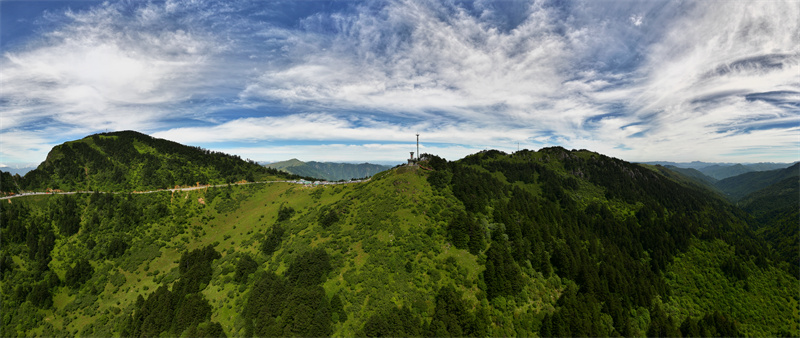
Shennong ding in the July
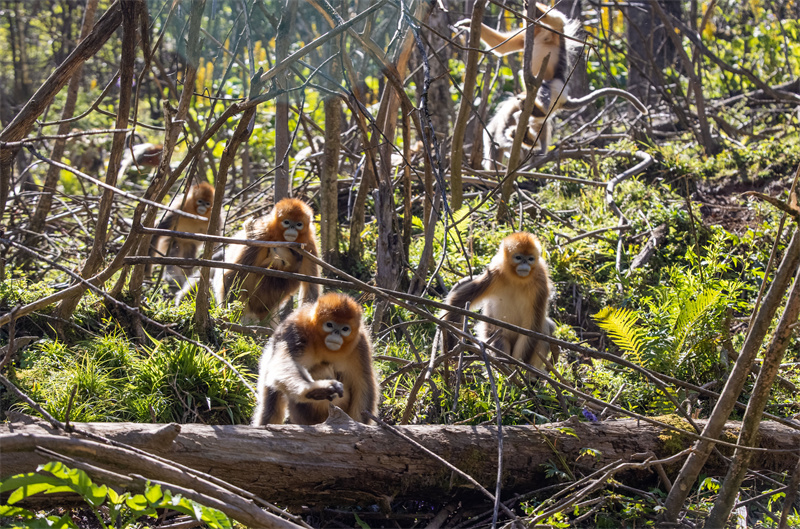
A group of golden snub-nosed monkeys rest in the grove by the stream
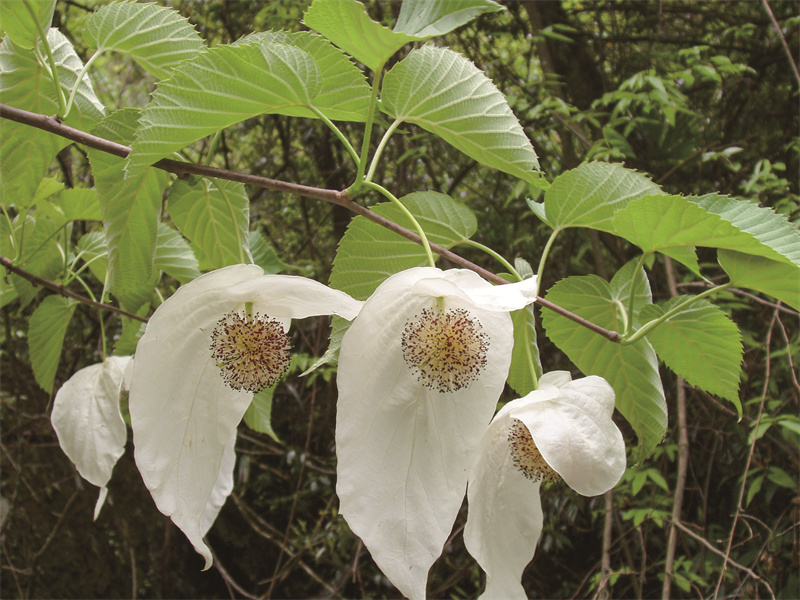
Blooming dove tree flowers.
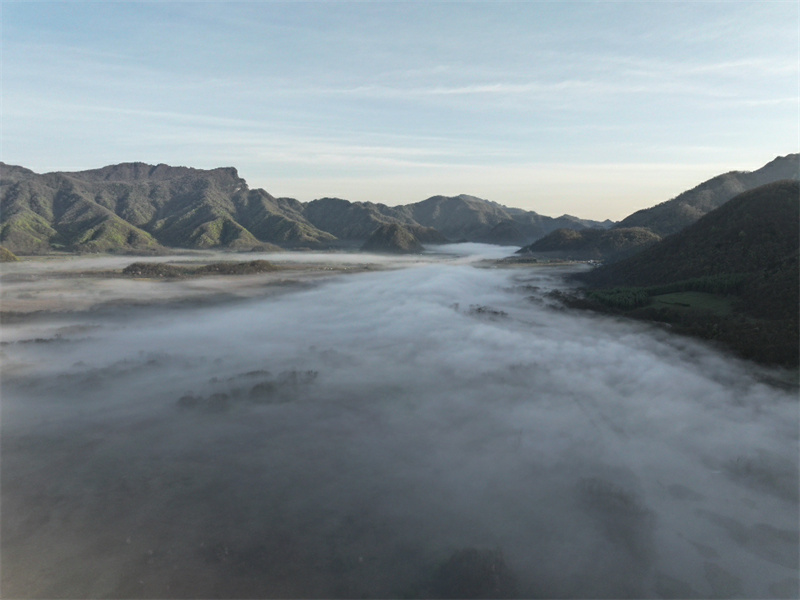
Thin fog on the Dajiuhu Wetland
【Rich Biodiversity Colorful World】
In the summer, venturing into Shennongjia, the highest land in Central China, you will find a group of “mountain spirits” adorned in golden fur “freely dancing and jumping” among the mountains. They were originally part of the entire golden snub-nosed monkey population in Qinling and Daba Mountains. However, due to geological shifts and human activities, the migration routes between Shennongjia, Daba, and Qinling Mountains were blocked and severed. As a result, this group of Shennongjia golden snub-nosed monkeys has been left isolated in the pristine forests, where they have thrived and multiplied to this day.
Recently, the results of the 4th golden snub-nosed monkey habitat monitoring and population survey in Shennongjia were released. It was reported that Shennongjia represents the easternmost distribution of golden snub-nosed monkeys globally and it is the only habitat in the world for Shennongjia golden snub-nosed monkeys, the Hubei subspecies of Sichuan golden snub-nosed monkeys. This population is a typical isolated subspecies with the smallest number. Encouragingly, there are now 11 groups of golden snub-nosed monkeys in this area, totaling 1,618 individuals inhabiting an area of 401 square kilometers. Compared to 2019, there has been an increase of 1 group, 147 individuals, and an expansion of 47 square kilometers in habitat area.
In the faint morning light, at the Dalongtan Field Research Base for Golden Snub-nosed Monkeys in Shennongjia National Park, Li Shuhang, a staff member, crossed over babbling brooks, tracing the tracks of golden snub-nosed monkeys amid towering ancient trees, verdant pines, and bamboos.
“In the Shennongjia area, spanning from the highest peak, Shennong Peak, at 3,106.2 meters above sea level, to the lowest valley of Shizhu River at 398 meters above sea level, there is an elevation difference of 2,708 meters. This range creates various climate conditions in low mountains, mid-elevational mountains and subalpine zones, supporting diverse plant communities typical of the most complete altitudinal vegetation spectrum in Central China. The golden snub-nosed monkeys inhabit the pristine and secondary forests at elevations ranging from 1,500 to 3,300 meters year-round,” said Li Shuhang.
This season is a prime time for the golden snub-nosed monkeys to frolic. They forage on vegetation, drink from mountain streams, leap between trees, and gather flowers and fruits. Li Shuhang occasionally looked up to observe along the way. “There are a total of six families of golden snub-nosed monkeys at the base, each consisting of 15 to 16 individuals. And they do not have a ‘king’. The ‘family head’, typically an adult male, serves as the core of each family unit. The peak birthing season is from March to May annually. Females typically give birth once every two years, with each birth resulting in a single offspring. They primarily inhabit trees but also forage on the ground, feeding mainly on leaves, tender branches, flowers, and fruits, with occasional consumption of tree bark and roots.”
Suddenly, the branches halfway up the mountainside began to sway violently. Amidst the shadows, figures of “spirits” leapt between the branches. Before long, a golden snub-nosed monkey “strode proudly forward”, leading a large group of them to the stream to drink water.
“Look, that is the ‘head’ of this family. We call him Shell. He was the first golden snub-nosed monkey I got to know, and his nose is very distinctive”. Li Shuhang pointed to a golden snub-nosed monkey sitting on a rock by the stream and said, “when I first arrived at the base, the monkeys would hide when they saw me. But one day, one of them jumped onto my shoulder and ‘groomed’ me. That’s when I knew they started seeing me as part of their family”. Li Shuhang smiled shyly when recalling intimate moments with the golden snub-nosed monkeys.
“Mom, look! The baby monkey is learning to climb trees from its mom!” exclaimed young visitor Wu Dongjun, pointing excitedly across the stream. “Golden snub-nosed monkeys are born with the innate ability to climb trees. They must quickly strengthen these skills to survive in the competitive natural environment where only the fittest prevail,” added Sun Kailin, a staff member at the research base. He has been living with the golden snub-nosed monkeys for 12 years. He is normally reserved, but when it comes to talking about golden snub-nosed monkeys, he becomes quite talkative.
The Dalongtan Field Research Base for Golden Snub-nosed Monkeys was established in January 2006. It is a rare domestic platform integrating conservation research and popular science education on golden snub-nosed monkeys. The base features a 1000-square-meter research and living area, a 500-square-meter exhibition hall for public education on golden snub-nosed monkeys, a habitat and behavioral monitoring platform, and a 3-kilometer educational trail. Over 100 renowned experts and scholars from more than 30 research institutions, including the Institute of Zoology of the Chinese Academy of Sciences, Beijing Forestry University, Huazhong Agricultural University, and Central South University, have conducted research at the base. Collaboratively, they have trained over 60 undergraduate, master’s, and doctoral students.
“It was at the Golden Monkey Ridge, reaching an altitude of 3,019 meters at its highest peak, where golden snub-nosed monkeys were first discovered in Shennongjia. The area is primarily dominated by mixed forests of cold-tolerant fir and broadleaf deciduous trees such as birch, with an abundance of negative oxygen ions reaching up to 160,000 per cubic centimeter. This region serves as one of the primary habitats and activity areas for golden snub-nosed monkeys. The ridge is covered with ancient trees that obscure the sky, where waterfalls cascade down, vines hang overhead, and moss and lichen carpet the ground, creating a seamless blend of water, light, and mountain scenery,” explained Cai Ju, a natural ecology study-tour guide in Shennongjia.
Shennongjia features an altitude difference of over 2,700 meters and a forest coverage rate of over 91%. It covers only 0.03% of China’s land area but hosts 11.7% of the nation’s higher plant species and 8.95% of vertebrate species. It is home to 25 nationally protected wild plants such as the dove tree and Chinese yew, with 33 endemic plant species. The region has 728 species of wild vertebrates and 5,385 insect species. It is habitat to 94 nationally protected wild animals including golden snub-nosed monkeys, forest musk deer, and Chinese tiger swallowtail butterflies.
As Yang Jingyuan, Director of the Scientific Research Institute of Shennongjia National Park expects, we aspire for the entire society to support the conservation of golden snub-nosed monkeys in Shennongjia. Let’s provide a broader home for rare flora and fauna and create a better world for humanity. (Staff Reporters Wang Jianhong, Zhang Rui; Staff Correspondent Liu Xinran)

Copyright Shennongjia National Park
Address:36 Chulin Road, Muyu Town, Shennongjia Forestry District, Hubei Province 鄂ICP备18005077号-3
Address:36 Chulin Road, Muyu Town, Shennongjia Forestry District, Hubei Province 鄂ICP备18005077号-3
Email:2673990569@qq.com
Phone:0719-3453368
Phone:0719-3453368


TOP