
Chinese giant salamander
Updated:2022-10-09 Source:Shennongjia National Park
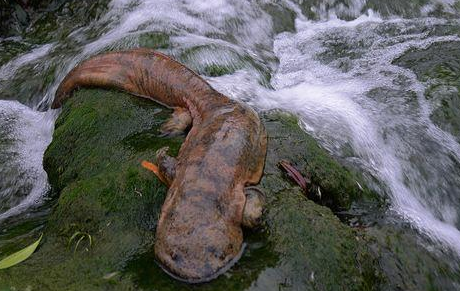
The Chinese giant salamander (Andrias davidianus) is an oviparous animal of the genus Andrias in the family Cryptobranchidae. It is the world's largest extant amphibian and a national Class II protected species of China. It is also commonly known as baby fish because it sounds like a baby’s cry. Known as a "living fossil", it is a rare species that survived 300 million years ago in the same era as the dinosaurs. The Chinese giant salamander is listed as a Critically Endangered (CR) species in the IUCN Red List of Threatened Species 2006 ver 3.1, as a Class II protected animal in China, and as a protected animal in Appendix I of the Washington Convention (CITES).
The Chinese giant salamander is long and resembles a lizard in appearance, except that it is much fatter and flatter in comparison. The body colour varies according to the colour of the habitat, with darker irregular spots on the surface and excellent protective colouration. Its head is flat and bluntly rounded, and eyes undeveloped without eyelids, because of whose unique structure, they are particularly photophobic. The Chinese giant salamander generally lives in the rocky crevices of mountain streams and caves with clear and fast-flowing water with back flows and low sand content.
The Chinese giant salamander is a fierce, carnivorous creature that feeds on aquatic insects, fish and shrimps. It attacks its prey as soon as it spots it passing. The teeth in its mouth are sharp and dense, making it difficult for the prey to escape once entering its mouth. Its teeth cannot chew, so it swallows its food with its mouth open and digests it slowly in its stomach. It has high hunger tolerance and will not starve to death even if it is kept in cool water for two to three years without eating. It overeats at times, gaining up to one-fifth of their body weight after a hearty meal, and can even feed on their own species or eggs when food is scarce.
The Chinese giant salamander breathes through its gills when it is young and through its lungs when it grows up. Because its lungs are imperfectly developed, it needs to use wet skin for gas exchange as an aid to breathing like frogs, which explains why they must live in or near water. From a biological evolutionary point of view, the Chinese giant salamander is a transitional type that evolved from a water-dwelling fish to a true terrestrial animal.
The Chinese giant salamander is found in all provinces except Xinjiang, Tibet, Inner Mongolia and Taiwan, where it has not been reported, and is mainly found in the mountain streams and rivers of the Yangtze and Yellow Rivers as well as the upper and middle tributaries of the Pearl River. Able to live up to 130 years in captivity, it has the longest life span amongst all amphibians.
According to statistics, there aren’t many Chinese giant salamanders existing in nature, and most of them inhabit hilly mountains. Their population is now affected by human activity, increased water pollution, and many other factors. To keep the existence of this ancient species that once lived with dinosaurs, we need to take care of the homestead they rely on.

Copyright Shennongjia National Park
Address:36 Chulin Road, Muyu Town, Shennongjia Forestry District, Hubei Province 鄂ICP备18005077号-3
Address:36 Chulin Road, Muyu Town, Shennongjia Forestry District, Hubei Province 鄂ICP备18005077号-3
Email:2673990569@qq.com
Phone:0719-3453368
Phone:0719-3453368


TOP