
Forest musk deer
Updated:2022-10-09 Source:Shennongjia National Park
Forest musk deer (Moschus berezovskii), a Class I protected animal, is the smallest in size in the genus Moschus. The adult forest musk deer weighs 6-9kg, is 630-800mm long and less than 500mm high at the shoulder. It is characterized by the absence of horns in both sexes. The upper canine teeth of a male musk deer are well-developed, long and pointed, exposed outside the mouth and shaped like fangs. Its hind limbs are 1/3 to 1/4 longer than the front limbs, so the hind part is obviously higher than the front part when standing. It has a short tail, long and slender limbs, narrow and pointed hooves, and long and erect ears. Its hair is coarse, stiff, wavy and easily broken. Its coat is dark brown in color without spots. Another distinctive feature of the coat is a relatively wide white band on each side of the neck, which extends to the armpits.
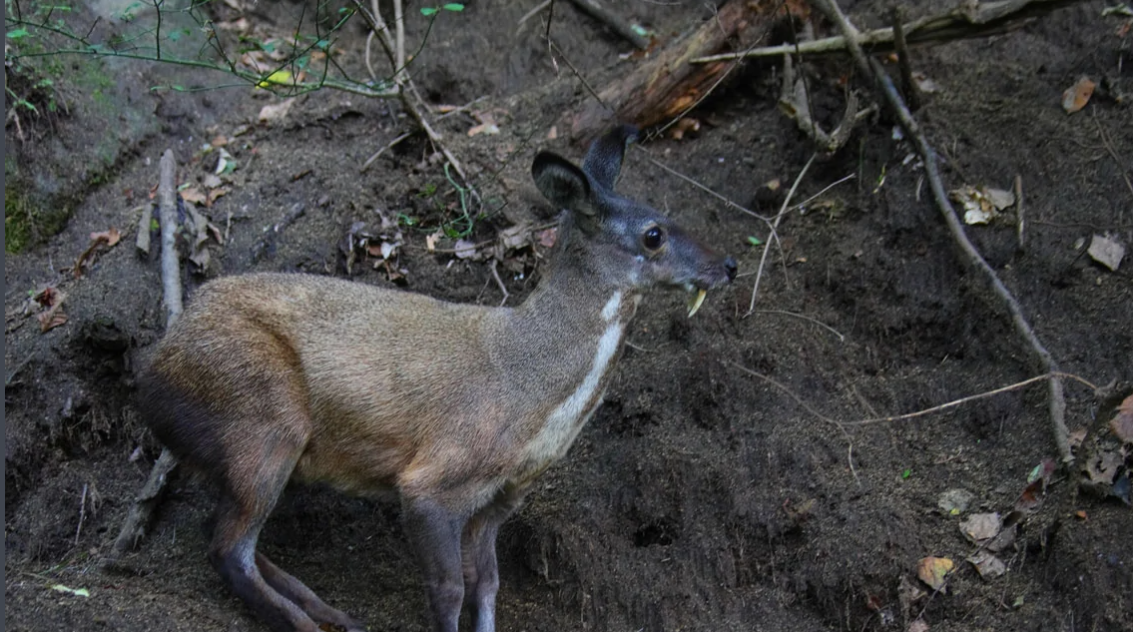
Physical characteristics
Both sexes are unhorned. The ears are long and erect with slightly rounded tips. The male musk deer has well-developed upper teeth that curve backwards and downwards and extend beyond the lower lip. The abdominal genitalia have musk bags in front of them, and the tail is thick and short with well-developed caudal fat glands. Its limbs are long and slender, while the hind limbs are longer than the forelimbs.
The body hair is coarse, hard and dark, olive-brown and tinged with orange. The inner ears and eyebrows are white. The tips of the ears are black and the bases are orange-brown. From under the lower jaw, throat, and neck to the front chest are well-defined white or orange areas. The lower jaw has a cream stripe, and the cream spots on lateral sides of the throat join together to form two cream bands that run from the front of the neck down to the chest. In the upper part of the neck is a broad band of dark brown against it. The legs and belly are yellow to orange-brown, and the rump fur is nearly black. Juveniles are spotted.
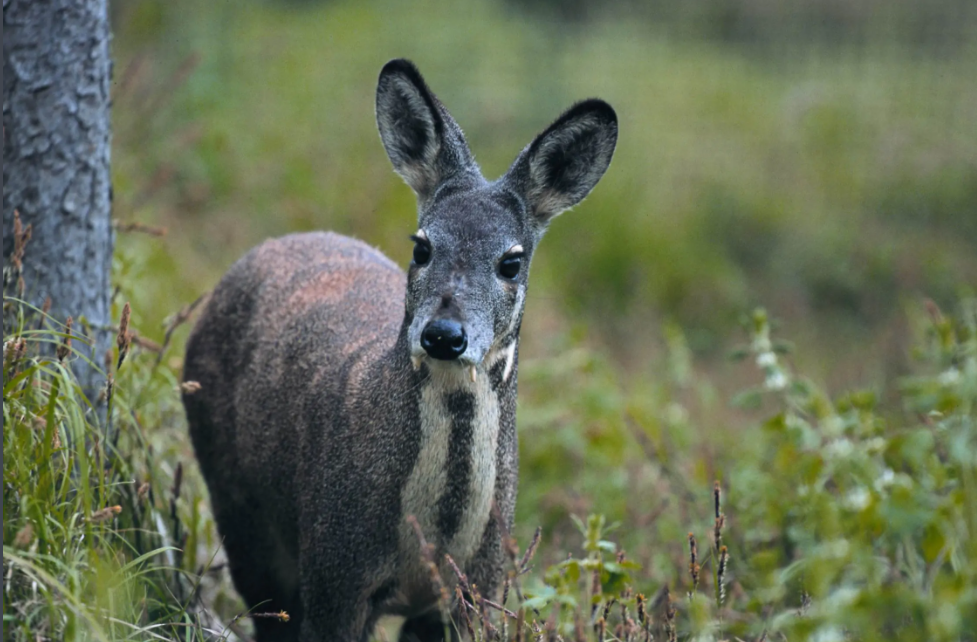
The forest musk deer mainly inhabits mixed coniferous and broad-leaved forests, while coniferous forests and less dense broad-leaved forests are also suitable habitats for them. They can live at altitudes ranging from 2,000 to 3,800 meters, but can also survive at lower altitudes. They feed on leaves, weeds, mosses, shoots, lichens and various wild fruits.
The forest musk deer is a timid and solitary animal that rests during the day and only comes out in the morning and dusk. Usually the male and female are separated and live a solitary life. The females often stay with their young, while the males use their huge musk glands to mark the territory and attract mates. Forest musk deer have a keen sense of sight and hearing and are quick to flee or hide in the rocks when they hear special sounds. They can walk briskly and agilely on precipitous cliffs, ascend inclined tree trunks, and stand on branches. They are also good jumpers, able to leap more than 2 meters from flat ground. 
Copyright Shennongjia National Park
Address:36 Chulin Road, Muyu Town, Shennongjia Forestry District, Hubei Province 鄂ICP备18005077号-3
Address:36 Chulin Road, Muyu Town, Shennongjia Forestry District, Hubei Province 鄂ICP备18005077号-3
Email:2673990569@qq.com
Phone:0719-3453368
Phone:0719-3453368


TOP