
Serow
Updated:2022-10-08 Source:Shennongjia National Park
The serow (Capricornis sumatraensis), is a typical forest-dwelling animal of the Bovidae family. It is one of the typical animals of the tropical and subtropical regions of southeastern Asia, mainly active in mixed coniferous and broad-leaved forests, coniferous forests or rocky scrub forests at altitudes of 1,000-4,400m. With deer-like antlers, cow-like hooves, donkey-like ears, and a goat-like head, it is known in China as the "four dissimilars" together with the reindeer, moose and elk. Because it was first discovered in Sumatra, Indonesia, it is also called the Sumatran antelope. In China, it is mainly found in Gansu, Qinghai, Zhejiang, Anhui, Hubei, Jiangxi, Sichuan, Yunnan, Tibet, Fujian, Guangdong, Guangxi and southern Shaanxi. The serow is a national Class II protected animal.
Morphological characteristics
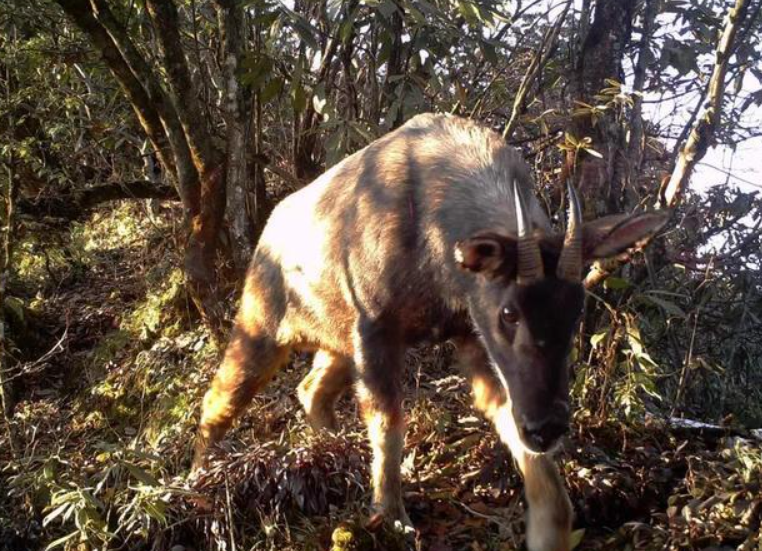
The serow is similar in appearance to a goat, but is slightly larger than a Himalayan Goral (Naemorhedus goral), with no significant difference in size between males and females. It is 140 to 190cm long, weighs 50 to 100kg, with a shoulder height of 86 to 110cm. It has a 9 to 16cm long tail and two particularly narrow, donkey-like ears which are 19 to 21cm long with pointed tips. Both female and male serows have a pair of short, smooth, pointed black horns between the two ears, which are far apart and simple in shape. The horns are rounded in cross-section and pointed at the end. The surface of the horns has circular ribs and irregular longitudinal grooves, with smooth tips. Generally, the horns of a serow are about 20-26cm long and 13-16cm in circumference. The longest pair of horns on record is 32.4cm long, from a serow in the Himalayan region. From the base of its horns to the back of its neck, there is a grayish-white mane over 10cm long, which looks very conspicuous. The muzzle black, the end of the muzzle bare, with moustache hairs around the lips. It has a conspicuous bulbous suborbital gland with a tuft of hair at its opening.
Its groins has 2 pairs of papillae. The body has a darker, predominantly black coat, interspersed with gray-brown hair, with an off-white or white hair base. Dark black ridges run the length of the spine. The upper and lower lips and jaws are dirty white or grayish white. Forehead and back of ears dotted with varying shades of brown. The mane on the back of the head and from the base of the horns to the back of the neck is long, white or grayish white, or mixed with brown or black. At a length of 15 to 20cm, the mane draped down from the neck is the most distinctive feature of the serow. The hairs on the limbs are russet, turning downwards to yellowish brown. The tail is not long and is of the same hue as the body.
Behavior
They usually live in small groups of 5 or 6, feeding on various weeds and leaves. They are rather solitary in nature. Apart from the males, who are always alone, both the females and cubs live in small groups of 4 to 5 at most, and never in larger groups. They come out in the morning and evening to feed and drink in forest clearings, forest margins or gullies, mainly feeding on grass, young branches, leaves, buds, fallen fruit, mushrooms and Usnea. Their feces are in the form of scattered piles.
In summer, they prefer to rest in secluded places such as under large trees, in thickets and between huge rocks; in winter, they often go to caves to escape the wind and spend the night. They have relatively fixed paths for foraging, resting places and fecal disposal sites, and they usually hang out between cliffs and walls or hide in dense forests.
Each individual or small group occupies a certain area. Thanks to its well-developed suborbital and hoof glands, it can use its secretions to mark the territory on trees or scrub at the edge of its habitat. Extremely adept at climbing and leaping, it can move freely between the steepest cliffs and walls or jump between rocky valleys. This is due to the fact that its hooves are made up of two sub-hooves that rest closely together, narrow and pointed at the front end and broad at the back end, ringed with horniness and composed of a soft central part that acts like a suction cup, enabling it to stand firmly or jump over steep rocks. In addition, it has sensitive peripheral receptors at the base of its hooves. When it’s moving, the hoof receives stimuli, which the receptors can convert into a signal that is transmitted to the central nervous system, which in turn converts the received signal into a control signal that is then transmitted to various different muscle groups on the limbs, thus regulating the balance of the body's centre of gravity. When disturbed, it is able to run quickly, jump over dangerous rocks and climb up cliffs to escape from enemies without returning. 
Copyright Shennongjia National Park
Address:36 Chulin Road, Muyu Town, Shennongjia Forestry District, Hubei Province 鄂ICP备18005077号-3
Address:36 Chulin Road, Muyu Town, Shennongjia Forestry District, Hubei Province 鄂ICP备18005077号-3
Email:2673990569@qq.com
Phone:0719-3453368
Phone:0719-3453368


TOP