Giant Panda
Updated:2021-10-22 Source:Shennongjia National Park
Name Card of the Giant Panda
The only species under the Giant Panda Genus, the Giant Panda Family
A flagship species of global biodiversity conservation
National Treasure of China
Logo of the World Wildlife Fund
The Giant Panda belongs to the Giant Panda Genus, the Giant Panda Family, Carnivora, Mammalia.
What does the Giant Panda look like?
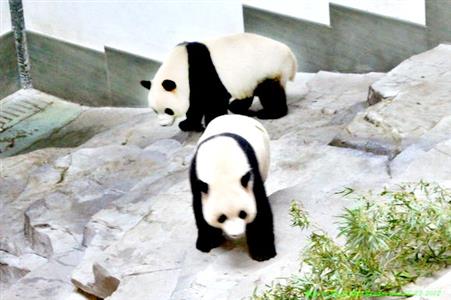
The Giant Panda has a bear-like fat body, round head and strong limbs. Its trunk and tail are white, its ears, eyes, limbs and shoulders are black, and its belly is light brown or ash black.
Where does the Giant Panda live?
The Giant Panda used to live in 14 Chinese provinces along the Yellow River and the Yangtze River, and even some countries in Southeast Asia.
However, it only lives in the mountain systems of Qinling, Minshan, Liangshan and Qionglai.
Shennongjia was one of the Giant Panda’s hometowns
According to fossil research and historical documents, Shennongjia was one of the hometowns of the Giant Panda. In 1996, Chinese Academy of Sciences found fossils of the Giant Panda in a cave in Hongping Town, Shennongjia.
Shennongjia is still livable for the Giant Panda
Located at the stretching branch of Qinling Mountain System, Shennongjia has similar climate, vegetation, landforms and eco-environment comparing to the natural habitats of the Giant Panda, such as Wolong in Sichuan Province and Qinling in Shaanxi Province. According to a survey by Hubei University in 2015, Shennongjia possesses abundant bamboo resources suitable for the Giant Panda to eat, with a distribution area of about 215km2 and a total biomass of about 750,000 tons, which is enough to provide for 65 Giant Pandas.
What does the Giant Panda eat?
99% of the Giant Panda's food is bamboo. Sometimes the Giant Panda also eats other plants and meat. The Giant Panda eats over 60 species of bamboo, including Indocalamus, Pleioblastus and Fargesia which is distributed in Shennongjia.
The Giant Panda eats a lot!
A Giant Panda eats 18-30 kilograms of bamboo per day. However, highly fibrous bamboo is too difficult for the Giant Panda's carnivorous digestive system, therefore only about 20% of the food can be absorbed while the other 80% is excreted very soon. So the Giant Panda spends 12-16 hours a day eating to get sufficient energy.
Natural Enemies of the Giant Panda
The natural enemies of the Giant Panda include Golden Eagle, Golden Cat, jackal, wolf, fox, Yellow-throated Marten and etc. They usually attack old, weak, sick, injured or young pandas.
Neighbors of the Giant Panda
In the wild the Giant Panda often shares its territory with Golden Snub-nosed Monkey, black bear, forest musk deer, tufted deer, serow, goral, yellow weasel and etc.
The Smell Communication of the Giant Panda
The Giant Panda often rubs or jets its secretion from the perianal gland under its tail into trees and rocks to mark its territory. In mating season this is also a way to attract the opposite sex.
The Cry of the Giant Panda
The Giant Panda also cries to communicate with each other. Different cries have different meanings, for example, barking like a dog means warning, and snorting or roaring means anger.
The Giant Panda doesn't hibernate
Unlike the black bear, the Giant Panda doesn't hibernate. In winter it migrates downhill and moves around as usual looking for food in the snow.
Loner in the Bamboo Forest
The Giant Panda usually lives alone in the bamboo forest. It doesn't settle down in one place, instead it sometimes sleeps in a tree hole or a rock cave and sometimes rests under a tree or in the bamboo forest. Its sensitive smell and hearing can give it pre-warning when human or its natural enemy approaches.
The Giant Panda likes to stay still to minimize energy consumption. Only in mating season the pandas break the ice and chase each other.
Master of Tree Climbing
The Giant Panda has sharp claws and strong limbs. Besides five clawed toes, its forefoot has the sixth toe, so it can neatly grab things or climb tree, which makes it easier for the Giant Panda to feed, sunbathe, play and escape from the enemy. Sometimes the pandas even mate in the tree.
The Giant Panda can’t stand the heat
Because of its thick hair the Giant Panda can't stand the heat. It prefers to live in cool and humid mountain or valley. When the temperature is above 20 degrees centigrade, the Giant Panda will feel uncomfortable.
In-situ Conservation of the Giant Panda
In-situ conservation of the Giant Panda means to establish nature reserves in its natural habitats to protect its population and habitats and maintain the regional biodiversity.
Ex-situ Conservation of the Giant Panda
Ex-situ conservation of the Giant Panda means to establish a self-sustaining population under artificial conditions, to realize population reconstruction and rejuvenation of wild population. Shennongjia is the first ex-situ population reintroduction site of the Giant Panda.
Research on the Conservation of the Giant Panda
Through over 8 million years surviving till today and becoming the “living fossil”, the Giant Panda must have many secrets we don’t know. To explore the origin and evolution of the Giant Panda and learn its survival strategies and multiplying law provides us technical support for the conservation of the Giant Panda.
The Mini Baby of the Giant Panda
The development of the newborn baby of the Giant Panda is immature. The average weight of the newborn is 145g, about 0.1% of an adult panda’s weight (80-140kg). The newborn has pink skin and sparse white hair. 1 week or 2 weeks later the skin on its ears, eyes, limbs and shoulders gets darker; when the baby is 3-6 weeks old black hair gradually grows out at the darker parts; when it is 6-8 weeks old its eyes open and its teeth start to grow; and 3 months after it was born it can crawl slowly.

Address:36 Chulin Road, Muyu Town, Shennongjia Forestry District, Hubei Province 鄂ICP备18005077号-3
Phone:0719-3453368