
My Story in Shennongjia: Chapter I
Updated:2023-06-16 Source:Shennongjia National Park
My story in Shennongjia began last summer. I had just started my postgraduate study in entomology. Out of curiosity about everything in nature, I was eager for an opportunity to conduct investigations and research in the wild. My supervisors sensed my strong desire, so they made a bold decision—Bai Ming, researcher at the Institute of Zoology, Chinese Academy of Sciences, and Liu Meike, professor at Yangtze University, decided, after discussion, to build an insect sampling plot for the SITE100 project in Qianjiaping, Shennongjia. This project followed the example of the plant sampling plot built by Jiang Mingxi, a researcher at the Wuhan Botanical Garden. They made this decision, of course, not only to fulfill my desire—they wanted to make a contribution to the investigation of the background resources in Shennongjia through research at the sampling plot.
When it comes to insect collecting, there are two commonly known methods: active collecting and passive collecting. For active collecting, the main tools include insect nets, beating sheets, and light traps. Because the tools are easy and convenient to use, active collecting has been widely adopted. Passive collecting, including collecting with Malaise traps, collecting jars, shallow soil traps, and flight interception traps, has attracted attention of scholars from China and abroad and has been adopted more widely than before in recent years because of its repeatability and the large amount of samples it can collect. At the insect sampling plot we have built, we mainly used passive collecting with pitfall traps, Malaise traps, and flight interception traps. Using these methods, we can collect insects at ground level, just above the surface, and in midair. The species and quantity of the insects we collect at different altitudes better reflect the diversity of insects in Shennongjia, which provides more reliable statistics for research on local biodiversity.
On June 18, 2022, when we first came to Muyu Town, the gentle breeze and sweet smell of nature was refreshing, and I couldn’t help breathing in the clean air like a voracious eater. I was suddenly overwhelmed by the satisfaction of escaping from the hustle and bustle of big cities. We were welcomed by Zhao Baolin, director of Qianjiaping Biological Laboratorial Base of Shennongjia National Park. He led us up the mountain and talked with us about his story in Shennongjia. His story further ignited our interest in this forestry district. Soon after our arrival, Yang Jingyuan, director of the Scientific Research Institute of Shennongjia National Park, and vice director Yu Huiliang called us to ask whether everything was going well. Their kindness made us feel extremely warm and assured us that we wouldn’t be alone with their strong support and generous assistance.
After quickly settling down, we started our “mission” in no time. We selected the ideal site for the sampling plot, located the position, and deployed sampling tools. Everything went smoothly. It was the first time we had been to such a mountainous area like Shennongjia. Having been accustomed to life on the plains, we felt it a great challenge to live in the mountains. The mountain roads were winding and bumpy, with lots of thorns in the way. When encountering huge rocks, we had to climb over them on all fours. Sometimes we had to carry very heavy equipment on long journeys. With no one to help us, we had no choice but to struggle ahead on our own. Sometimes when we worked outside at night, the plunge in temperature and the bitter wind made us shiver. These are just some examples of the difficulties we have faced. At the same time, however, there have been rewards, such as the surprise we got when we saw the sunset’s glow cloaking the whole mountain and the excitement we felt when we finished building the collection equipment. In this process, we have also gained more confidence every time we have overcame another challenge, more strength after we solved another problem, and more courage after experiencing the struggles of starting from scratch.
Su Dongpo wrote in his poem, “Listen not to the rain beating against the trees. I had better walk slowly while chanting at ease. Better than a saddle I like sandals and cane. I’d fain, in a straw cloak, spend my life in mist and rain.” I felt like what we were experiencing in Shennongjia could be described by the next part of this poem, “Drunken, I am sobered by the vernal wind shrill. And rather chill. In front, I see the slanting sun atop the hill; turning my head, I see the dreary beaten track. Let me go back! Impervious to rain or shine, I’ll have my own will.”
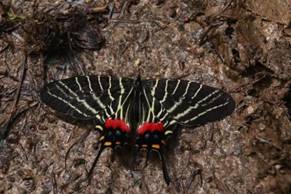
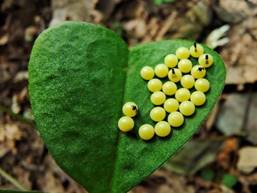
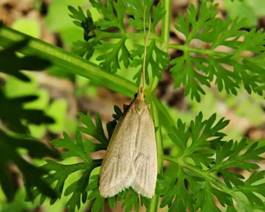
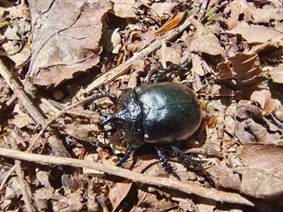 Hexapods on our way up the mountain
A year later, in the summer of 2023, we set off for Shennongjia once again. Different from last year, the researcher Bai Ming came to Yangtze University on June 2 to instruct us in person in the development of the insect sampling plot in Shennongjia and the arrangement of the samples. Mr. Bai also delivered a lecture on “The Next Generation of Entomological Taxonomy,” which inspired the teachers and students in attendance, and also gave us a great deal of motivation.
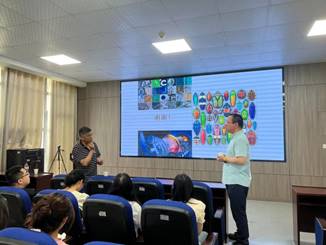 Researcher Bai Ming’s lecture at Yangtze University
On June 8, 2023, on our way up to the mountain to change the collection equipment, we encountered Professor Wei Cong of Northwest A&F University, who was conducting research and collection work in Qianjiaping with a group of postgraduate students including Xie Zhen, Zhang Junru (Northwest A&F University), Lei Qilong, Liu Huaiyu, and Xiong Haoyang (China Agricultural University). This was also an interesting team, just like us. Professor Wei gave us sincere encouragement and even helped us carry the equipment and set shallow soil traps. We made fun of ourselves by chanting together, “In the forests of Shennongjia, we dig dig holes, set little little traps, and we enjoy ourselves…”
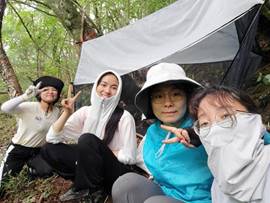
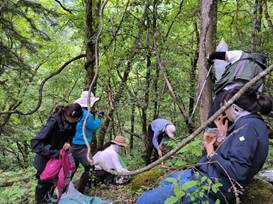 Setting Malaise traps, pitfall traps, and other passive collecting equipment
In Shennongjia, there is not only beautiful scenery and warmhearted people, but also diverse species. What a preciously gorgeous place it is! Walking in the remote mountains of Shennongjia, we never feel alone, because there is always a group of people who are forging ahead side by side with us for the great undertaking of exploring the biodiversity in Shennongjia National Park.
I am impressed by the saying cited by researcher Bai Ming at the meeting of our research group which goes, “Though the green mountains are silent, we can feel they are at ease. The stream, though flowing and leaving no trace, gives us a sense of calmness.” When I went to bed at night, the scenery I had seen on our way to the sampling plot reappeared in my mind. At that moment, I seemed to have a deeper understanding of the profound meaning behind these two sentences.
Zhou Xuan, Institute of Zoology, Chinese Academy of Sciences & Yangtze University
Written in Shennongjia on June 14, 2023

Copyright Shennongjia National Park
Address:36 Chulin Road, Muyu Town, Shennongjia Forestry District, Hubei Province 鄂ICP备18005077号-3
Address:36 Chulin Road, Muyu Town, Shennongjia Forestry District, Hubei Province 鄂ICP备18005077号-3
Email:2673990569@qq.com
Phone:0719-3453368
Phone:0719-3453368


TOP