Shennongjia National Park Bred 52 Species of Rare Plants
Updated:2021-12-10 Source:Shennongjia National Park
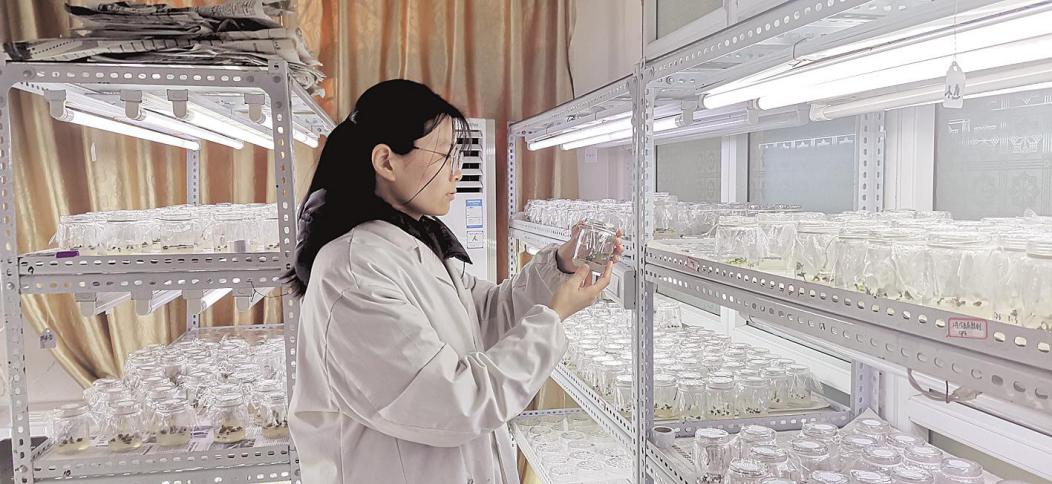 A technician observing the cultivation of rare plants at the Science Research Institute of Shennongjia National Park. (Photo by Liu Hanze &Yu Ling)
By Liu Hanze & Yu Ling
Shennongjia has 155 species of rare plants and abundant germplasm resources. In recent years, Shennongjia National Park has made achievements in plant protection and successfully bred 52 species of rare plants.
200,000 seedlings of rare plants have beencultivated
"In Cabinet No. 5, Armeniaca hongpingensis (Hongping apricot) seedlings grow normally..." Jiang Zhiguo, Director of the Biodiversity Conservation and Research Laboratory of the Science Research Institute of Shennongjia National Park, wrote down in his work diary the condition of rare plants in the lab on Feb. 3.
The lab was established in 2010 to conduct research on the cultivation, storage and utilization of rare plant germplasm resources. Hongping apricot is one of the rare plants artificially cultivated in the lab.
Jiang explained that the distribution area of Hongping apricot in Shennongjia is very small, and only a dozen plants were found. Hongping apricot is a natural hybrid of apricot and plum, which is of great value in the study of apricot hybrid.
In 2018, the lab began to use their young buds, young leaves, seed embryos, shoots and other materials for tissue culture. After three years of efforts, Hongping apricot seedlings were successfully bred in 2020.
Outside the lab, at the ex-situ conservation site, a fenced-in, five-to-six-square-metre field stands out with a sign that says "Shennong Silene".
"Although it's a bunch of dead grass now, it will turn into beautiful flowers after a few months." According to Yu Huiliang, Deputy Director of the Science Research Institute of Shennongjia National Park, Shennong Silene was discovered as a new species in 2020, with only about 10 plants found. Researchers have carried out protection and research on it at the base.
"Shennongjia has 155 species of rare plants, 52 of which have been successfully bred." Yu introduced that the Institute has set up more than 100 mu of rare plant conservation bases in Guanmenshan, Laojunshan Mountain, Qianjiaping and other places, and cultivated more than 200,000 seedlings of rare plants such as Manglietia patungensis, phoebe zhennan yichang and Tetracentron sinense, etc.
40,000 specimens witness the evolution of nature
Emmenopterys henryi Oliv., Cercidiphyllum japonicum Sieb. Et Zucc, Torreya fargesii... Walk into the Bioligy Pavillion of Shennongjia Nature Museum in Guanmenshan, and rows of specimens will catch your eyes.
The pavillion is a popular science education base set up by the Science Research Institute of Shennongjia National Park. It has12,000 plant specimens of over 2,000 species, including more than 60 ancient relict species known as "living fossils".
In recent years, the Institute has undertaken and participated in more than 10 research projects of the National Science and Technology Support Program, "863" Program, and other national major special programs. It has trained more than 80 postgraduates in cooperation with more than 40 domestic scientific research institutes and universities.
Since 2010, Shennongjia National Park has invested significantly in a background survey of natural resources. It has collected and preserved more than 1,000 specimens of aquatic organisms, more than 3,000 specimens of algae and fungi, more than 16,000 specimens of higher plants and more than 20,000 specimens of insects.
Luo Dongliang, Chairman of CPPCC and Deputy Secretary of the Party Committee of Shennongjia Forestry District, introduced that Shennongjia is promoting the construction of a "Noah's ark" for local flora and fauna, so as to offer meticulous care for these unique seeds.
Link
Expert suggests building national biological germplasm resource bank in central China’s Shennongjia
Shennongjia is one of the China's 14 key biodiversity conservation and research areas of international significance, known as the "shelter" of species from Tertiary and Quaternary ice age, "Green Treasure House", "the gene pool of species" and "Garden of Medicinal Herbs".
Shennongjia is rich in biological germplasm resources, with 4,276 species of higher vascular plants, including 205 endemic species, 155 species of rare plants, 24 species of national key protected plants, and 98 species are listed in the China Species Red List.
These plants are of great conservation and utilization value. Taking Chinese herbal plants as an example, 70% of the higher plants in Shennongjia are herbal plants, accounting for about 1/6 of the total traditional Chinese medicine resources in China and more than 2/3 of that in Hubei, making Shennongjia a true "Medicine Storehouse of Central China".
In recent years, Shennongjia has contributed a lot in collecting and preserving plant specimens. "However, the biological value of specimens is much less than that of well-preserved seeds." Liu Yifei, a professor at Hubei University of Chinese Medicine, suggested that a germplasm resource bank could be built to make up for this weakness.
At the end of December 2020, the Central Economic Working Conference proposed that to solve the problem of seeds and cultivated land, we should enhance the protection and utilization of germplasm resources and strengthen the construction of seed banks.
Germplasm resource bank is a national strategic materials reserve and an important means of gene resource protection. In the 1950s, American geneticists discovered a Heterodera glycines Ichinohe resistant gene from wild soybean resources in China, from which he bred a new disease-resistant variety and saved the soybean industry in the United States. Based on the quality genetic resources in Chinese kiwifruit, New Zealand geneticists bred a kind of red kiwifruit, which has become the new favorite in the fruit industry when exported to China.
Liu Yifei believes that it is of great significance to establish a Central China biological germplasm resource bank in Shennongjia and use modern biotechnology to store "super seeds" with high yield, high quality and strong adversity resistance, which can play a dual role of protection and demonstration.

Address:36 Chulin Road, Muyu Town, Shennongjia Forestry District, Hubei Province 鄂ICP备18005077号-3
Phone:0719-3453368